Nadi Shodhana
What it is
Nadi Shodhana (Nadi Shuddhi) is an ancient, foundational practice — hailed in the Vedas and the yogic and tantric scriptures such as the Hatha Yoga Pradeepika, Gheranda Samhita and Shiva Samhita. These classical texts state that Nadi Shodhana is the one practice to master before any other pranayama.
Yet this profound practice is rarely taught in its complete form today — it has largely slipped out of mainstream yoga, preserved instead within authentic, living traditions. For this, we remain deeply grateful to the Gurumandala — the living lineage through which these timeless teachings and practices have been preserved and transmitted across generations.
More than alternate‑nostril breathing
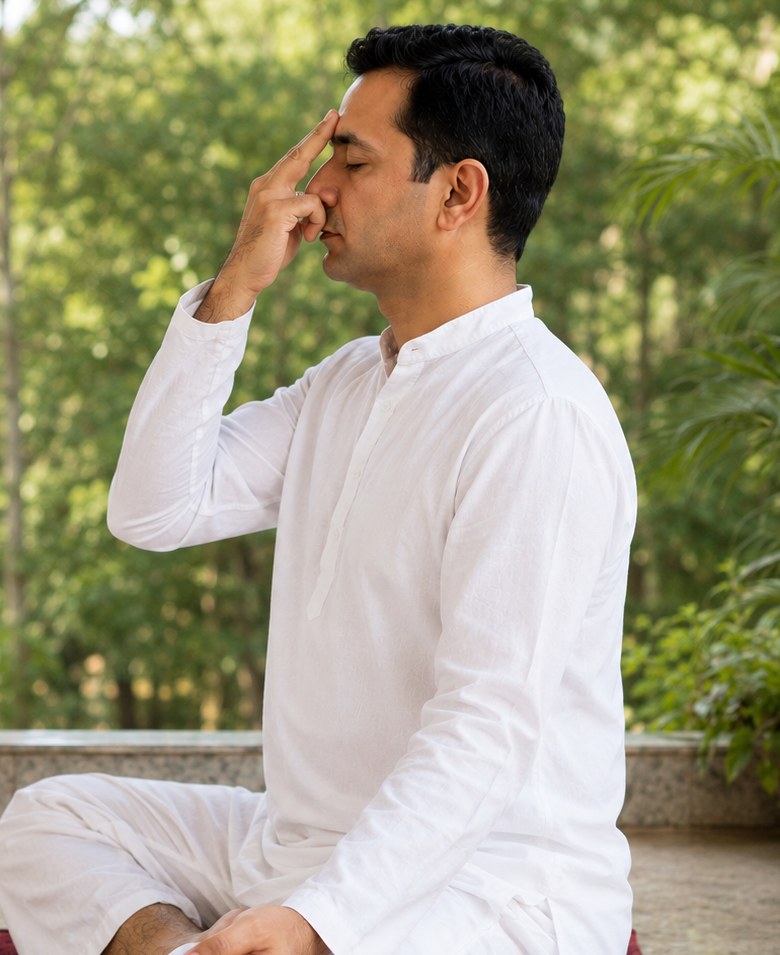
Nadi Shodhana is often misunderstood as simply alternate‑nostril breathing. Yet in the Yogic tradition its purpose extends far beyond the mechanics of inhaling through one nostril and exhaling through the other. The Sanskrit reveals the deeper intent:
- Nadi — the subtle pathways through which Prana flows.
- Shodhana — purification, cleansing, refinement.
So Nadi Shodhana is not merely about alternating the breath between the nostrils. The breath is the means; the balancing and purification of the Nadis is the process.
What it gives you
As the breath becomes balanced and refined, the movement of Prana finds greater equilibrium. Purification happens; natural healing is triggered. The body settles, the mind grows quieter, and the practice gradually creates the conditions for a deeper, more inward journey.
Done properly, Nadi Shodhana promotes physical health, removes stress, balances the chakras, and deepens meditation. This is why it has traditionally held such an important place in preparing for the deeper practices of Yoga and Pranayama.
What the research says
Nervous-system balance
- In studies of Nadi Shodhana pranayama, regular practice has been linked to lower blood pressure in people with hypertension.
- Practice is associated with improved heart-rate variability — a marker of a well-balanced, resilient nervous system.
Sources: Nadishodhana & Bhramari pranayama in hypertensives — RCT (2023); Nadi Shodhan as an adjunct in hypertension — exploratory RCT (2025).
Calm & steadiness
- Slow, conscious yogic breathing shifts the balance toward the calming (parasympathetic) side of the nervous system.
- It is associated with steadier attention and a lower stress response.
Source: Zaccaro et al., slow breathing & autonomic function (Frontiers in Human Neuroscience, 2018).
Learn it the authentic way
From time to time, Yoga Shakti conducts dedicated Nadi Shodhana workshops to introduce the practice and explore its deeper dimensions.
The workshops are suitable both for those encountering Nadi Shodhana for the first time and for practitioners who have learnt or practised it before but would like to deepen their understanding.
In their words

Upcoming workshop
7:00 PM IST
Nadi Shodhana — The Healing Breath
The yogic cleansing breath — learn it the authentic way.
Any questions? Message us on WhatsApp →
Questions
Is the workshop free?
Yes — the Nadi Shodhana workshop is completely free.
Do I need any experience?
None at all. It's taught step by step — beginners are welcome.
Is Nadi Shodhana safe?
Practised correctly, yes. The workshop teaches the do's and don'ts so you practise safely.
How long is it?
A focused, guided workshop lasting around 90 minutes.
How do I join?
Register here — you'll then be added to the workshop WhatsApp group, where the invite and joining link are shared before the session.